Section outline

  • welcome!

    Imagine a village that was supposed to get clean water but didn’t because funds were misused. This course aims to prevent such tragedies by promoting financial integrity, fight corruption, and ensure compliance for SMC – Faith in Development partners.

    In this module you will:

    • learn how to spot and stop mismanagement and corruption in SMC-funded interventions, and
    • discover what to do if you come across these problems.

    With six real-life examples, you'll get practical tips and tools to handle fraud situations. This course takes around 45 minutes to complete, and you'll receive a certificate afterward.

    Below Charlotta Norrby, Secretary General of SMC, explains why it is important to fight corruption!

      Photo:

  • introduction

    • For SMC to realize its vision, it is crucial that as much of our funds as possible directly benefit the communities we aim to support. Additionally, we have responsibilities to Sida, our primary donor, and the Swedish taxpayers. Considerable efforts are dedicated to ensuring that funds are managed responsibly and effectively.

      By corruption, SMC refers to: 

      "the misuse of resources, trust, power, and/or position to gain 
       undue benefits for oneself, a relative, or a group. Benefits may
       include both financial and other advantages. Corruption may
       also involve failure to take action, for example by not reporting 
       a suspected individual".

      Allegations of Sexual Exploitation, Abuse, and Sexual Harassment (SEAH) should also be reported to SMC. Reporting should be done in a manner that does not jeopardize the safety of the individuals involved.


  • Corruption around the world

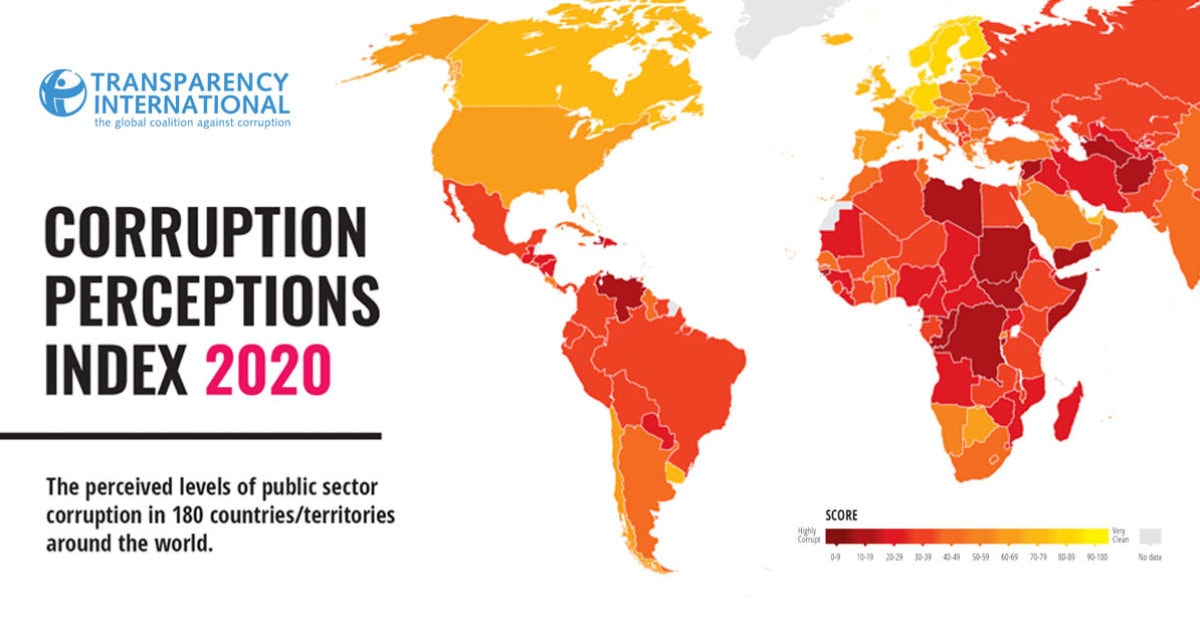
    Transparency International annually compiles the Corruption Perception Index, based on the perceived level of public sector corruption in various countries. This map shows the 2023 results, with dark red countries repre-senting those perceived as the most corrupt (having a low score), while yellow countries indicate the least corrupt (with a high score). If you want to read more about the results for each country, click on the link below.

     A worldmap of perceived level of corrution in the public sector in 2018    Link Link to:  Transparency International


    Video - What is corruption? 


    • FINANCIAL INTEGRITY

      Financial integrity is all about tackling corruption and financial irregularities, not just because it's required, but because it's morally right. SMC’s role is to work bottom-up to increase the financial integrity among members and partners, as well as to empower civil society organisations to fight corruption in their local contexts.

      STEPS FORWARD

      Here are some practical steps you can take to prevent corruption and financial irregularities: 

      •  First, understand your organisation's stand on this issue, typically outlined in an Anti-corruption policy or Code of conduct. 
      • Second, ensure compliance with all relevant procedures, such as those for hiring, procurement, and financial management, even if they may seem burdensome or time-consuming. 
      Corruption and financial misconduct can only be eliminated if we join forces to confront them. Should you ever suspect such wrongdoing in your intervention, you have to report it.


      GUIDELINES AND INTEGRITY                    

      In many of the countries where SMC member organizations and partners operate, corruption is perceived to be high. This significantly increases the risk of our work being affected by corruption. It is essential that beneficiaries, taxpayers, and donors trust that we are taking every possible measure to combat corruption and fraud.

      In doing so, we rely on clear guidelines and procedures, but also on the integrity of our staff, member organisations and partners. Every member, partner, and recipient of funds from SMC must agree to and follow the SMC Anti-Corruption Policy or their own corresponding policy.

      Please spend some time reading the document. You can open it by clicking on the image below. 


                         Downloadable file:                            SMC's Anti-corruption 
                            and SEAH Policy

               Image of a policy document.


       ALWAYS PREVENT * NEVER ACCEPT * ALWAYS INFORM * ALWAYS ACT


  • cases for reflection

    The course presents six real-life scenarios of fraud and corruption that can arise unexpectedly in your daily work and life.               

    CASE 1: incomplete Receipts

    When you're buying cars, equipment, food, or office supplies, you must obtain the proper documentation and proof of payment. There might be times when you  must come up with creative solutions. But when is it okay to insist on a receipt and when is it ok to find an alternative solution while adhering to the code of conduct?  Look at the example below to see some dilemmas you might face.

    Proceed to the first case by clicking on the arrow below.

    • Understanding financial irregularities

      Situations like these are common and you must know how to handle them. While an incomplete or missing
      receipt is not necessarily corruption or fraud, the best way to prevent irregularities is to ensure that your 
      organisation does not purchase anything without a receipt. Proper and accurate documentation is always 
      required when purchasing items for project purposes. Without receipts and proof of payment for items 
      purchased, irregularities or misuse of funds may occur. 

      Financial irregularities can include: 


  • Case 2: Workshops

    Workshops and meetings are important in implementing interventions. But organising them
    comes with various costs, like buying food, arranging the equipment, and hiring staff. These costs
    can add up quickly. For example, you'll need to order food, rent equipment, and hire extra help to
    run the event.

    Check out a case example to see what might happen when you plan your workshop.
    • Understanding embezzlement

      As you see, embezzlement occurs when someone, like a workshop manager, unlawfully misuses assets or funds they're supposed to handle responsibly, often for their gain. In simpler terms, it's like they are stealing money or resources, that they're supposed to be taking care of, for personal benefit or the benefit of their organisation.

  • Case 3: Authorities

    3A. EXTORTION

    Sometimes, you might encounter situations where you're asked to pay a fee to continue your operations, 
    pass through a checkpoint, or receive goods. While we don't support paying in these cases, personal safety 
    might sometimes make it necessary. Consider the following case:

    • Understanding extortion

      This incident involves an abuse of authority, where someone exploits their position to demand illegal payments, endangering your safety. Extortion differs from bribery, as bribery entails an  offer to benefit or assist, In contrast, extortion involves a threat of harm. These threats can include physical harm or blackmail.

    • 3B. DEALING WITH FACILITATION PAYMENTS AND BRIBES 

      Are facilitation payments or small bribes to public officials frequent in your work environment? 
      It's typical to encounter customs challenges when anticipating equipment arrivals from overseas. 
      Explore the linked case for guidance on managing bribes and facilitation payments effectively.


    • Understanding bribery
      Bribery is sadly a common form of corruption. When you're caught in a scenario like the one mentioned earlier, figuring out the right course of action can be tough, especially when you need those goods. But it's important to keep in mind that accepting or giving bribes goes against SMC's anti-corruption rules. Terms like "facilitation payments," "speed payments", "grease payments," or "processing fees" are all considered corrupt practices.
  • Case 4: Procurement

    Do you sometimes manage your organisation's purchasing of IT equipment, vehicles, office
    supplies, or other items? Follow this scenario to learn how to deal with corrupt behaviour in
    procurement situations.


    • Understanding nepotism

      When personal relationships impact professional decisions, it may lead to favouritism or nepotism if not handled appropriately. Merely having a family or close connection to a contractor or supplier doesn't necessarily imply nepotism, if you follow the official procurement procedures. Nepotism or favouritism occurs when someone in authority uses their power to grant jobs or favours to family members, even if more qualified candidates are available. This can also involve allocating higher salaries or benefits to employees who are relatives of management.
  • Case 5: Benefits

    Across cultures, giving gifts and invitations to business partners is a common custom. When is it okay 
    to receive a gift related to your work in an NGO or a church, and when should you be alert that the gift 
    could be a bribe? The following case will help you make the right decision.

    • Accepting invitations and gifts

      Navigating this area can be tricky. Not all gifts are bribes, but it's essential to consider whether a gift is trying to influence your decisions. Think about the timing – does it coincide with a big decision about a supplier? If you're unsure, discuss it with colleagues and seek advice. If there's a conflict of interest, report it to your supervisor and follow the anti-fraud and anti-corruption guidelines.

  • Case 6: Greater good

    Financial irregularities can be hard to spot. They might be intentional, but sometimes they happen 
    by mistake and with good intentions. Check out the case below and think about what to do next.

    • Unintentional financial irregularities

      Sometimes, financial irregularities, including corruption, aren't as clear as they seem. In the case 
      above, actions were motivated by a desire to serve "the greater good". However, despite noble 
      intentions, the outcome led to embezzlement and fraud. The organisation sought to minimize 
      administrative costs in the project budget, aiming for maximum cost efficiency. To avoid such 
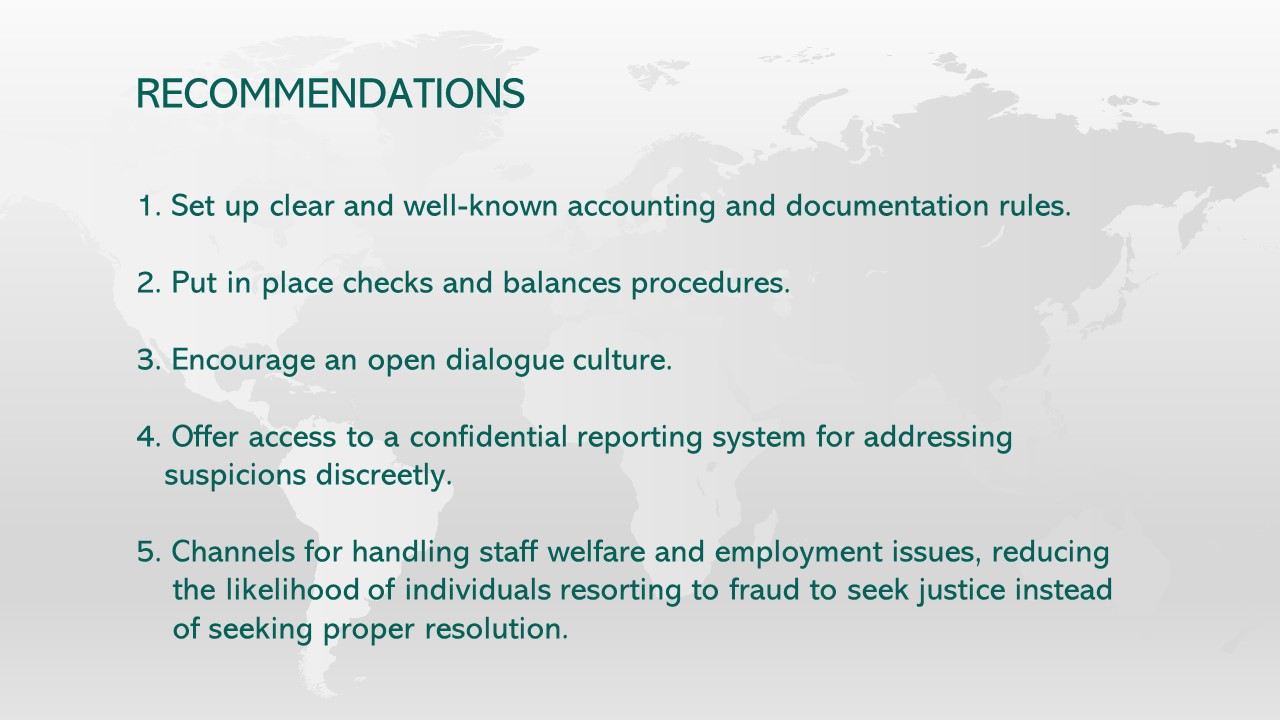
      situations in the future, consider the following recommendations.


  • Preventing, detecting, and managing irregularities

    Preventing cases of financial irregularities

    • How do you encourage an organisational culture where honesty, openness, and ethical behaviour are valued to prevent financial wrongdoing?
    • What measures are in place to minimise the risk of human error and intentional misconduct?
    • What guidelines does your organisation follow regarding employee behaviour, procurement practices, managing conflicts of interest, and accepting gifts?


    Detecting cases of financial irregularities

    • How does your organisation regularly check for financial irregularities, including routine reviews and targeted measures like spot checks and investigations?
    • Are employees and collaborators required to report suspected misconduct, known as whistleblowing, as per SMC's anti-corruption policy?
    • For further details, please refer to SMC’s anti-corruption policy.


    Handling cases of financial irregularities

    • How does your organization handle cases of financial irregularities reported through whistleblowing channels?
    • What consequences or sanctions are there for those involved in financial misconduct?


  • Roles & Responsibilities

    When facing suspicions of corruption and financial irregularities, knowing the appropriate steps 
    to take and whom to contact for assistance is crucial. Click through the slides below to understand 
    more about roles and responsibilities.

  • Test your knowledge

    Almost done with the course!


    Just one more task to finish before you're done with this module. Please take a quick quiz 
    to reinforce your learning throughout the course.

  • Feedback

    Feedback image

    Let us know what you think!

    We hope you have enjoyed this course. Please use the form below to any feedback or comments you may have. 

    Thank you!

  • Certificate of Completion

    Congratulations!
    Great job! You have completed the course Managing Finances with Integrity. You can now download and print your certificate of completion.
    • Click to return to SMC ONBOARDING