Section outline

  • Introduction

    Welcome to ACT’s Humanitarian Response Online Toolkit!


    The purpose of the Online Toolkit is to provide its members with all the necessary and relevant information and tools to allow them to undertake their specific tasks during an emergency response in a timely and efficient manner.    


    Practically speaking, the Online Toolkit is a webpage that is dedicated to humanitarian response.  It is intended to be a “one-stop shop” where all information, tools, policies, protocols and guidance needed can be found to carry out an emergency response.  Moreover, it is structured in such a way that it is easy to navigate.  


    ACT Humanitarian Mechanism

    For several months now, ACT’s Humanitarian Mechanism (HM) has been under intense revision and the fruits of this lengthy process are nearly ready to be savored.  The revised HM addresses the need for improved speed, quality and scale to enable a more effective ACT response to people affected by crisis.  In a nutshell, the following new exciting changes can be expected: 


    • Elimination of the "one-size fits all" approach
    • Tools and administrative procedure have been streamlined and are multi-purposed
    • Resources are easily accessible via an online platform (ACT's Humanitarian Toolkit)
    • Use of the Core Humanitarian Standard (CHS) as the ACT framework for quality and accountability
    • Integration of humanitarian advocacy within our response


    The video below provides an overview of how the changes to  ACT's Humanitarian Mechanism (HM) improve the quality and effectiveness of the assistance we provide to communities and affected people.


  • Section 1: Policies

    ACT Alliance’s Humanitarian Mechanism (HM) is the operationalization of two policies: 1- the Humanitarian Policy (2021) and 2- the RRF policy (2016).   These policies are available in English, French and Spanish.

    1. The Humanitarian Policy (2021)

    http://actalliance.org/documents/act-alliance-humanitarian-policy/

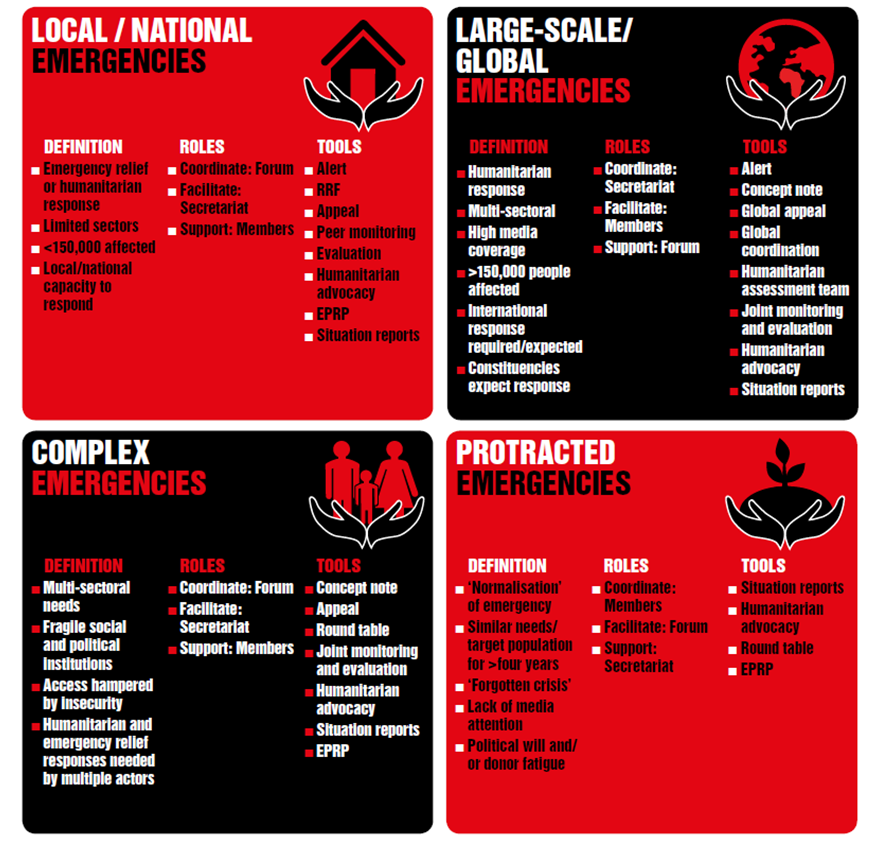
    The most significant change in the 2021 Humanitarian Policy was the elimination of a “one-size fits all” approach and the introduction of a context specific mechanism that offers different tools, processes, roles and timelines adapted to different categories of emergencies to enable a more efficient and effective response in different contexts.

    Categories of emergencies

    2. Rapid Response Fund Policy (2026) 

    HUMANITARIAN - ACT Alliance

    The RRF is ACT’s main mechanism for locally led response in accordance with the localisation agenda of the Grand Bargain. The primary purpose of the ACT RRF is to provide financial resources to members of the ACT Alliance during the impact of a disaster that people are suffering the most, and where national members have the capacity to respond. 

    The emergency could be of a rapid onset nature (e.g. earthquake or flood), slow onset emergency requiring early response or emergency relief (e.g. drought), or of a complex humanitarian character (e.g., refugee or internal displacement situation, resulting from breakdown of social, political, and economic systems). These disasters are mostly small or medium sized emergencies that require immediate response to urgent needs.  Requesting members are strongly encouraged to use the RRF funds as leverage to access other funding.  RRFs will be implemented within six months, with the possibility to extend for one month. 

    Rapid-Response-Fund-Guidance.pdf

  • Section 2: Processes and Tools

    Section 2 is dedicated to processes and tools.  Processes refer to the context specific procedures and protocols to follow according to a set timeline during the different categories of emergencies. Members will find all the mandatory and relevant tools members are required to use during each category of emergency under the flow diagrams.   Each tool is accompanied with a guidance note.


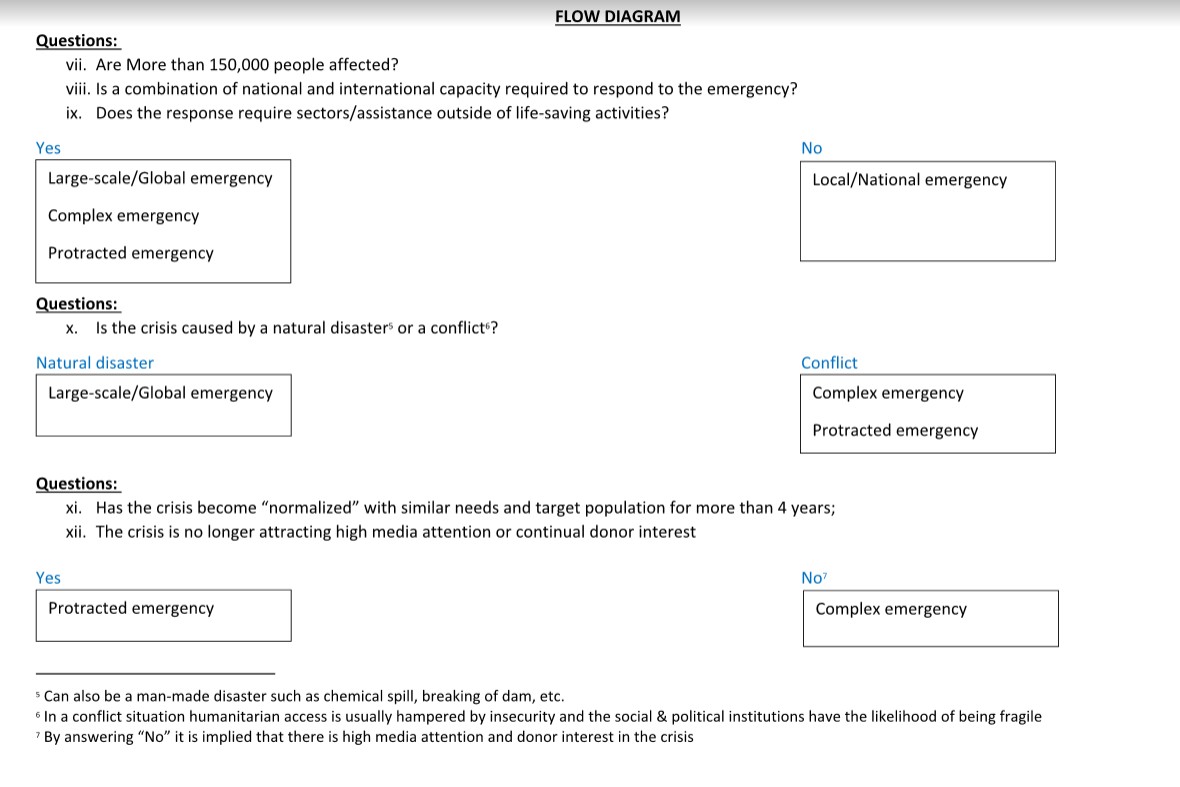
    Members can use the categorizing emergencies flow chart below to help determine which category of emergency they find themselves in, or they can scroll down to the relevant category of emergency.  


    Categorization flow chart


  • Section 2.1: (Local / National) Emergencies

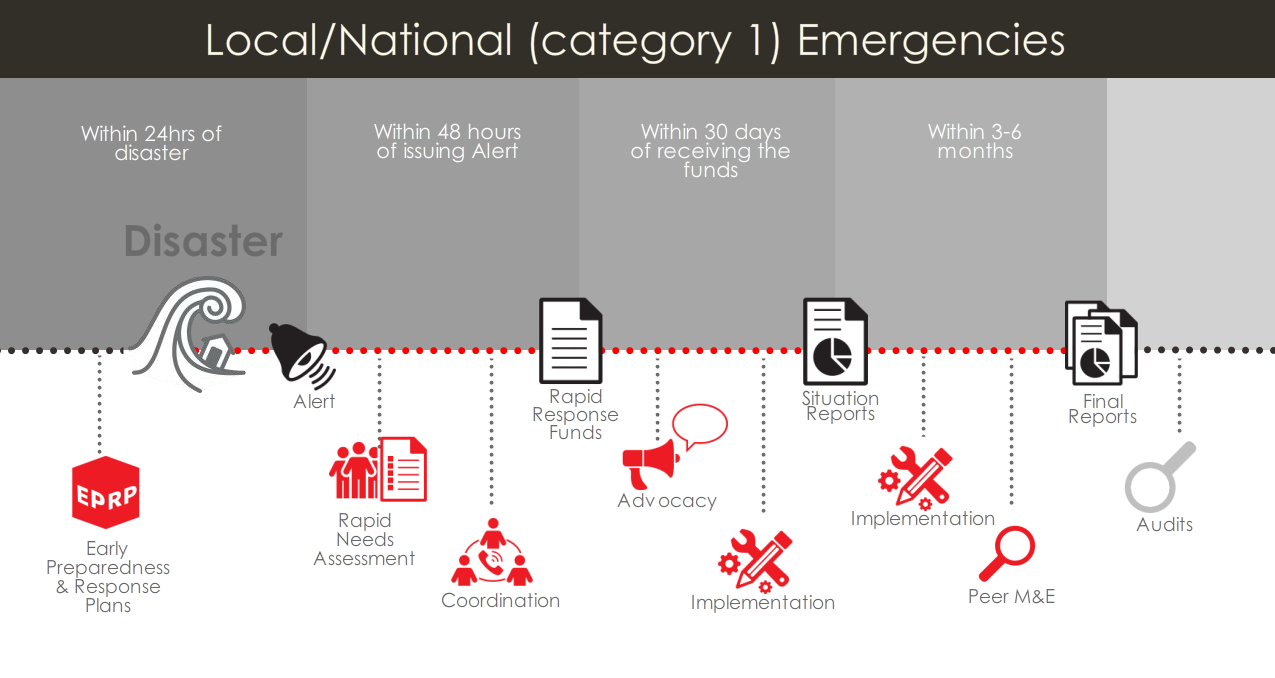
    A category 1 emergency is described as a sudden onset emergency requiring emergency relief or humanitarian response.  Some of the key criteria are the following:

    • Less than 150,000 people are affected
    • A limited sectoral response is required
    • The needs can be met by a single actor or a combination of national actors
    •  It can be country wide, or within a specific region/community within a country (including in the context of a protracted crisis).
    • Little global media attention


    Click to see interactive diagram:

    diagram cat 1

    • Tools

      All tools can be downloaded using the following link:

      http://actalliance.org/humanitarian-mechanism-templates/

      Scroll down to the section labelled "Revised Humanitarian Mechanism Templates"

    • Alert (sudden onset)

    • Alert (slow onset)

    • advocacyHumanitarian Advocacy

    • rapid neddsRapid Response Fund (RRF)

    • appealAppeal

    • Situation ReportsSituation Reports

    • Final Reports Final Reports 

    • Early Preparedness and Response Plans (EPRP)Early Preparedness and Response Plans (EPRP)


  • Section 2.2: (Large-scale / Global) Emergencies


    Category 2 (Large-scale / Global) Emergencies

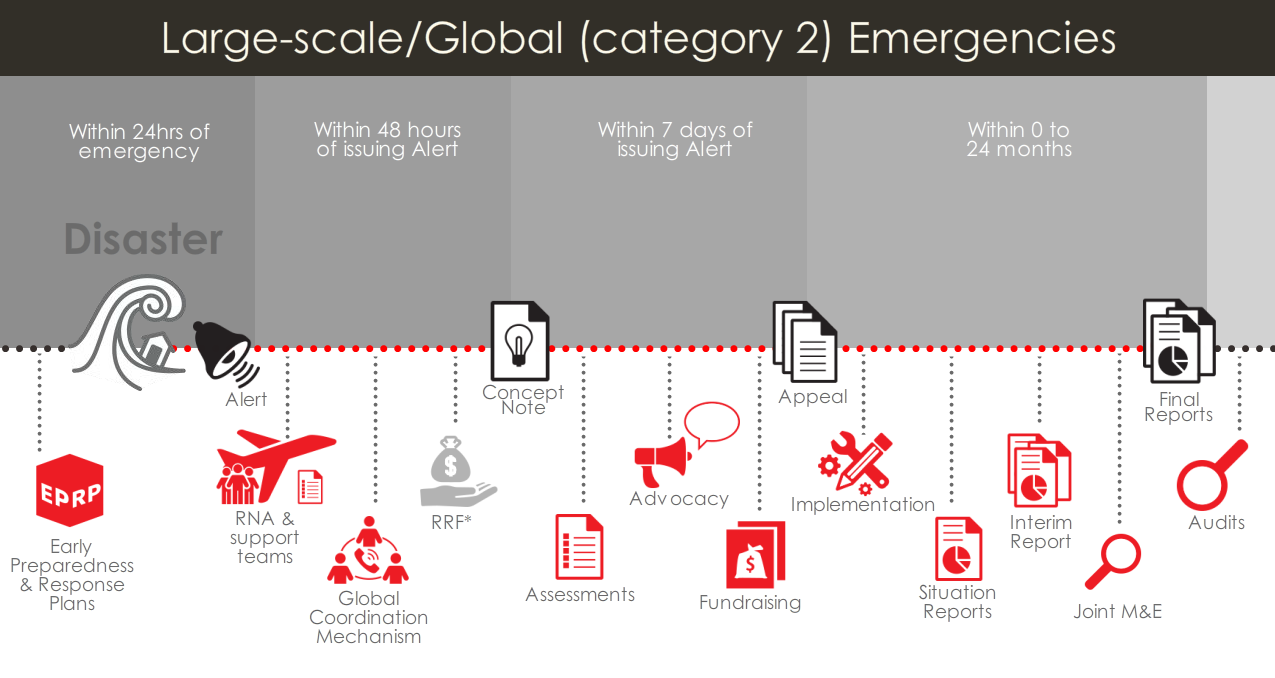
    A category 2 emergency is described as a sudden onset emergency requiring humanitarian response.  Some of the key criteria are the following:

    • More than 150,000 people are affected
    • A multi-sectoral response is required
    • The needs must met by a combination of national and international actors 
    •  It can be national or regional
    • High media coverage globally
    • Local capacity to respond is overwhelmed, response capacity from national governments is compromised and international response is requested/expected.


    Click to see interactive diagram:

    Cat2_image

    • mappeTools

      All tools can be downloaded using the following link:

      http://actalliance.org/humanitarian-mechanism-templates/

      Scroll down to the section labelled "Revised Humanitarian Mechanism Templates"

    • alertAlert (sudden onset)

    • alertAlert (slow onset)

    • rapidRapid needs assessment & support teams

    • advocacyHumanitarian advocacy

    • RRF* (start-up)RRF* (start-up)

    • Concept NoteConcept Note

    • AdvocacyAdvocacy

    • AppealAppeal

    • Situation Reports (SitReps)Situation Reports (SitReps)

    • Interim/Final ReportsInterim/Final Reports

    • Early Preparedness and Response Plans (EPRP)Early Preparedness and Response Plans (EPRP)

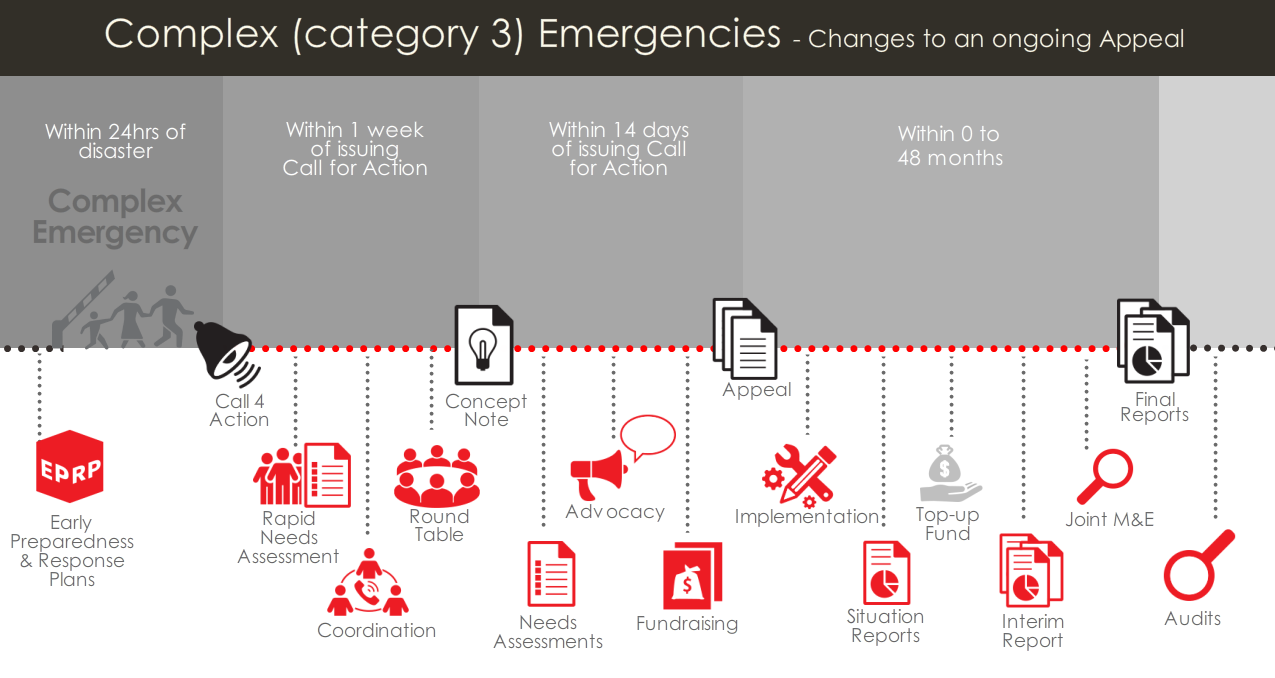
  • Section 2.3 (Complex) Emergencies

    Category 3 (Complex) Emergencies

    A category 3 emergency is described as a complex emergency requiring humanitarian and emergency relief response.  Some of the key criteria are the following:

    • More than 150,000 people are affected
    • A multi-sectoral response is required and the needs must met by a combination of national and international actors 
    • It is often regional, spills over into neighbouring countries 
    • Humanitarian access is severely hampered by insecurity
    • Fragile social and political institutions
    • Massive displacement of people
    • There is global media attention


    Click to see interactive diagram:

    cat3_screen view


    • toolsTools

      All tools can be downloaded using the following link:

      http://actalliance.org/humanitarian-mechanism-templates/

      Scroll down to the section labelled "Revised Humanitarian Mechanism Templates"

    • Call for actionCall for action

    • Humanitarian AdvocacyHumanitarian Advocacy

    • Concept NoteConcept Note

    • AppealAppeal

    • Situation Reports (SitReps)Situation Reports (SitReps)

    • Interim/Final ReportsInterim/Final Reports

    • Top-up fundTop-up fund

    • Early Preparedness and Response Plans (EPRP)Early Preparedness and Response Plans (EPRP)

  • Section 2.4 (Protracted) Emergencies

    Category 4 (Protracted) Emergencies

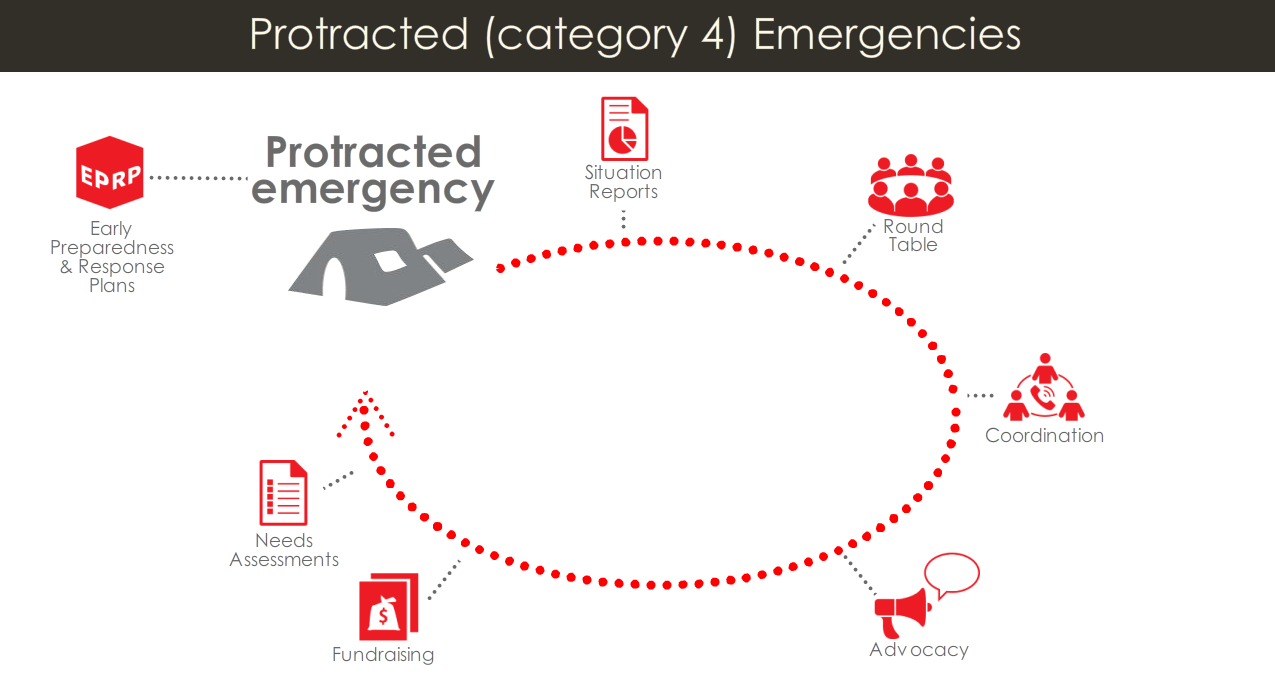
    A category 4 emergency is described as a complex emergency that extends into a protracted crisis. Some of the key criteria are the following:

    • More than 150,000 people are affected
    • Characterized as complex, but requiring more than 4 years of engagement by the ACT Alliance 
    • The emergency has become "normalized" with similar needs and target population for more than 4 years 
    • Lack of media attention, i.e. "forgotten crisis" 
    • Lack of political will to engage, donor fatigue


    Click to see interactive diagram:

    category 4 diagram

    • toolsTools

      All tools can be downloaded using the following link:

      http://actalliance.org/humanitarian-mechanism-templates/

      Scroll down to the section labelled "Revised Humanitarian Mechanism Templates"

    • Humanitarian AdvocacyHumanitarian advocacy

    • Situation Reports (SitReps)Situation Reports (SitReps)

    • Early Preparedness and Response Plans (EPRP)Early Preparedness and Response Plans (EPRP)

  • Section 3.1: Internal resources

    In this section, members will find links to optional tools, guidance and resources which are useful for programming and implementing humanitarian responses.    

    • tollsInternal resources

    • Tools and guidance for field practitioners - subfolderTools and guidance for field practitioners - subfolder

    • CHS accountability toolsCHS accountability tools

    • Beneficiary selection toolBeneficiary selection tool

    • Guidance on how to allocate un-earmarked fundsGuidance on how to allocate un-earmarked funds

    • How to do joint programming (consortium)How to do joint programming (consortium)

    • Proposal and report writing - subfolderProposal and report writing - subfolder

    •  Training materials - subfolder Training materials - subfolder

    • Lessons learned - subfolderLessons learned - subfolder

  • Section 3.2 External resources